Why Uniforms Matter More Than You Think in Your Laundromat
Mar 23, 2026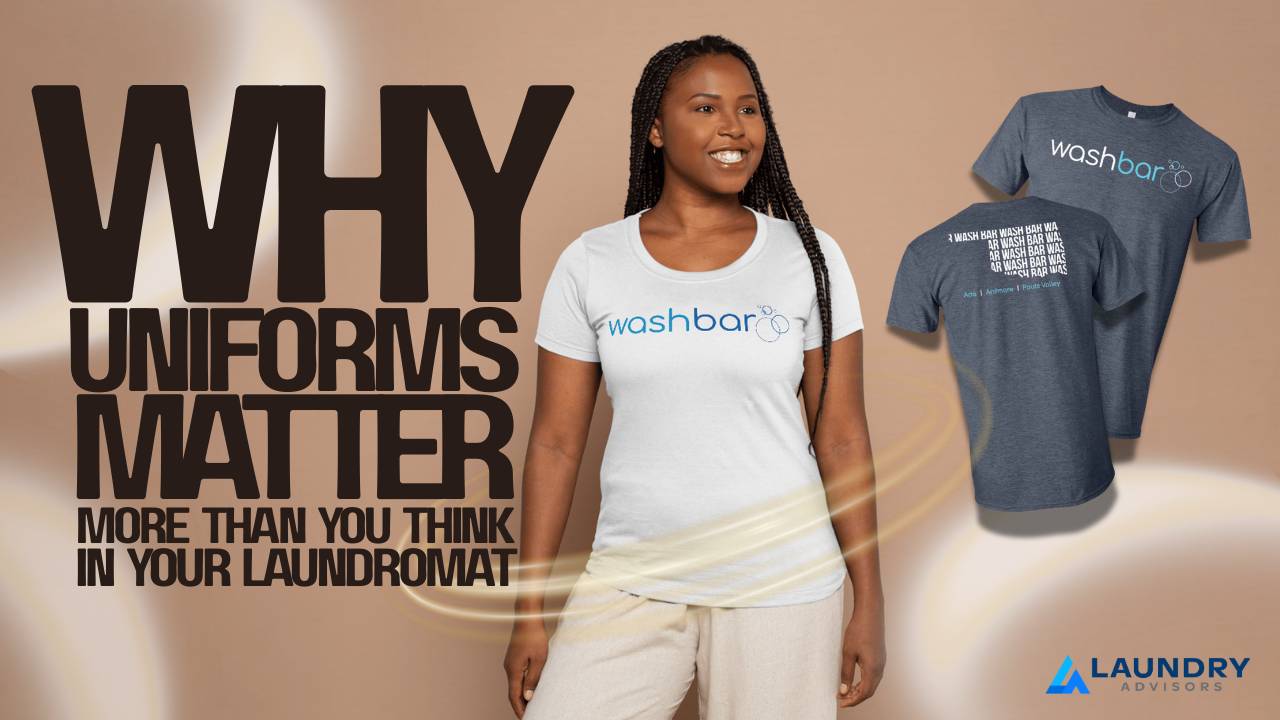
Staff Standards That Actually Stick
If you want consistency in your laundromat when you’re not there, this is one of those “small” decisions that quietly fixes a whole lot of problems.
Let me tell you about my thoughts on uniforms.
When we first opened Wash Bar, we didn’t have branded shirts yet. We asked attendants to wear a solid color shirt with closed-toed shoes. Reasonable, right? And honestly, it worked great, as long as we were physically in the building.
But the moment we weren’t there, our “standards” started turning into suggestions.
Attendants would show up wearing t-shirts with logos and imagery we didn’t agree with. Nothing against them personally, but it diluted the brand we were building and created a messy, inconsistent customer experience. That’s when we learned the hard truth:
Standards without enforcement are just wishful thinking.
The shift that changed everything
Once we could afford it, we started providing Wash Bar branded t-shirts and we updated our employee handbook to make uniforms non-negotiable.
Our policy was simple:
- Employees are required to wear Wash Bar branded shirts while on shift
- First offense results in a write-up
- Second offense results in losing the monthly bonus
No gray area. No debating. Clear expectation, clear consequence. And almost overnight, compliance stopped being an issue.
Uniforms aren’t about control, they’re about clarity
A lot of owners (and mainly employees) think uniforms are about being strict. I don’t see it that way. Uniforms are about clarity, especially in a self-serve environment.
When every attendant is clearly identifiable, customers instantly know:
- Who works there
- Who to ask for help
- Who the authority figure is
That alone reduces friction in your store. Customers feel more at ease because they’re not guessing who is in charge. They know who to go to with questions, problems, machine issues, refunds, or wash-and-fold information. That comfort builds trust, and trust drives repeat business.
Your staff becomes the “expert” automatically
Here’s something I didn’t fully expect: uniforms changed staff behavior too.
When attendants wore branded shirts, they carried themselves differently. They acted more confident. Customers treated them with more respect. They became the go-to people in the laundromat, not just someone “hanging around the counter.”
The uniform signals authority and professionalism. It’s hard to slack off when you’re literally wearing the logo on your chest.
If you want consistency, make uniforms a priority
If you want your standards followed when you’re not present, uniforms cannot be optional. Not “preferred.” Not “recommended.” Required.
Put it in your handbook. Provide the shirts. Enforce it every single time. Tie it to something that matters, like bonuses, performance reviews, or shift priority. Because if you don’t, you’ll eventually have a store full of mixed messages, and customers will feel it.
And yes, there’s a bonus
When an employee quits or gets fired, they’ll probably keep wearing the shirt around town. Is it ideal? Not always. But it is free advertising, and your brand stays visible in the community. I can't tell you how many times I've been walking through Walmart and I've seen an ex-employee wearing one of our shirts, while shopping.
My Parting Thought
Uniforms are a small investment with an outsized return. They create clarity for customers, authority for staff, and consistency for your brand, especially when you’re not in the building. If you want your attendants to be seen as the experts and the go-to people in your laundromat, put them in a uniform and mean it.
Want my exact handbook language and enforcement framework?
Inside Laundry Advisors, we share real SOPs, employee standards, and systems that help you run a professional store without you having to be on-site 24/7.
Explore Laundry Advisors Resources
Pro tip: If your “uniform policy” is currently a suggestion, your staff will treat it like one. Ask me how I know.
FAQ: Laundromat Uniforms and Appearance Standards
Do uniforms really affect sales or customer loyalty?
Indirectly, yes. Uniforms create clarity, trust and professionalism. Customers feel more comfortable asking for help, and comfort leads to repeat visits and higher conversion into add-on services like wash-and-fold.
What if an attendant forgets their shirt?
Have a backup plan: keep a few clean extras on-site in common sizes. If they still “forget” regularly, that’s a behavior problem, not a laundry problem and it should be handled through your policy.
Should uniforms be tied to bonuses?
If you pay a monthly bonus (performance, attendance, etc.), it’s a simple accountability lever. The key is consistency: if you enforce it sometimes, you’ll get “sometimes” compliance.
What should the uniform standard include besides shirts?
Keep it simple: branded shirt, closed-toed shoes, clean appearance and optional items like name tags. Your goal is customer clarity and a professional look, not a fashion runway.
What about employees keeping shirts after they leave?
It happens. Some owners collect them, some don’t. If you do collect, put it in the handbook and treat it like any other company property. If you don’t, consider it brand visibility, just make sure your team’s conduct is strong while they’re employed.
Stay connected with news and updates!
Join our mailing list to receive our weekly blog.
Don't worry, your information will not be shared.
We hate SPAM. We will never sell your information, for any reason.